Castle / Ruins Sights in Ibiza — 6 of Our Favourites

Discover and book the top Ibiza sights

The drawbridge, Dalt Vila Ibiza

1. Castell de Eivissa (Ibiza Castle)

Location
Ibiza Town

The whole of the Old Town of Ibiza (Dalt Vila) has become an outdoor museum with signs that lead you through the citadel's history and multitude of medieval buildings towards the castle at the centre.

When the Arabs ruled Ibiza (Yebisah) they built a large fortress, much of which is still standing today with buildings that have been built around it. Evidence of the Punic period and the Moorish occupation were discovered in the excavations of the castle.

There are two main defensive structures still standing:

  • The "Baluarte de Sant Jaume" currently has an exhibition on the weapons used to defend the walls of Ibiza, showing visitors how the use of firearms affected the structure of the buildings.
  • The "Baluarte de Sant Pere", on the other hand, houses an exhibition explaining how those walls were built, including a reproduction of Renaissance scaffolds.
Torre des Molar (Balansat Tower), San Miguel

2. Torre des Molar (Balansat Tower), San Miguel

Part of the wide network of watchtowers that dot Ibiza's coastline, Torre des Molar, also known as Torre de Balansat or Torre de Sant Miquel is located 95 metres above Port de Sant Miquel.

It was finished in 1763 following a design by engineer Juan Ballester y Zafra. It has two floors and an upper platform, all joined by a stone spiral staircase embedded in the thick walls. The entrance is located on the first floor, and it was reached with a rope ladder although in the 20th century a new access was built.

The tower is open to the public and it boasts wonderful views over the islets of S'Illa Murada and S'Illa des Bosc, as well as Port de Sant Miquel and the Benirras coastline.

The windmill at Puig d'en Valls Ibiza

3. Puig d'en Valls Windmill, East Ibiza

Location
Ibiza Town

When you travel across the island you will see many remnants of windmills, once glorious, and now just a few spokes sticking out from a ruined tower.

However, in Puig d'en Valls, just a few minutes from Ibiza Town you will find a wonderfully restored windmill, originally built in the 18th century and in operation up until the 1940's. It is a flour windmill, with a cylindrical base and walls of at least a meter thick. The promulgation of a decree of ban on food production halted production, as happened with other mills on the island.

Situated on a quiet hillside this is a beautiful place to come and escape the crowds. If you are doing a whistle stop tour of the island by car or moped then this is an absolute 'must see' on you list. With great views back over to the Dalt Vila and Ibiza Town plus a calm and tranquil surrounding make this an ideal picnic place.

Torre de ses Portes 16th century watch tower

4. Torre de ses Portes (watch tower), South East Ibiza

The tower is at the end of a south-pointing spit of land with two of Ibiza’s best beaches running back north on both sides, fashionable Las Salinas to the west and nudist beach Es Cavallet to the East.

Perched out on Ibiza’s most southern tip is the ancient defence tower Torre de ses Portes - a 16th century look out tower. Still standing and in remarkably sturdy condition.

The tower was located on this point to guard against approaching pirates and it’s clear to see why, the view out across the ocean is absolutely unparalleled

Phoenician Settlement of Sa Caleta

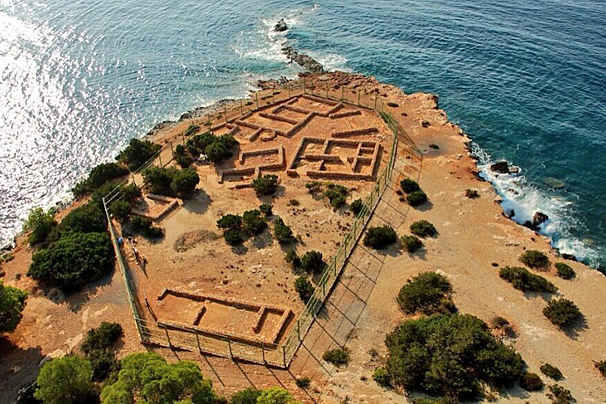
5. Sa Caleta (Phoenician Settlement), South Ibiza

Sa Caleta was the first settlement of the Phoenicians in the 8th century BC. Evidence shows they settled here for around 50 years before relocating to Eivissa and abandoning Sa Caleta forever.

Excavations here didn't start until the 1990s when scientists discovered the foundations covered an area of 10 acres. Evidence of metal work, iron work and even the layout of houses can be seen at these ancient remains.

A factor in the choice of the location was its proximity to the natural salt marshes of the island. The Phoenicians exploited this valuable natural commodity. The shallow pools of seawater within the marsh evaporated under the hot summer sun enjoyed by the island, leaving a gleaming crust of salt crystals. The Phoenicians collected these deposits and so began the first commercial enterprise of the island.

The origins of the settlement date back to the late 8th century BC. However, it may initially have been a seasonal base for economic and geographic expeditions in the Pitiusas (Ibiza and Formentera), as well as for exchanges between the south and the eastern and north-eastern coasts of the Iberian Peninsula. Around the year 600 BC the settlement was abandoned, probably because the inhabitants of Sa Caleta moved to the Bay of Ibiza.

The urban structure of Sa Caleta is based on narrow streets and small communal squares, where ovens for the use of the whole village were located. Many of the communal and domestic hearths were used for the smelting of galena in order to obtain silver, although the inhabitants of Sa Caleta also procured iron and bronze.

A UNESCO World Heritage Site, this area is visible to tourists exploring the coastline but is fenced off so that this delicate archaeological site cannot be disturbed.

S'Argamassa Roman Aqueduct, Santa Eulalia

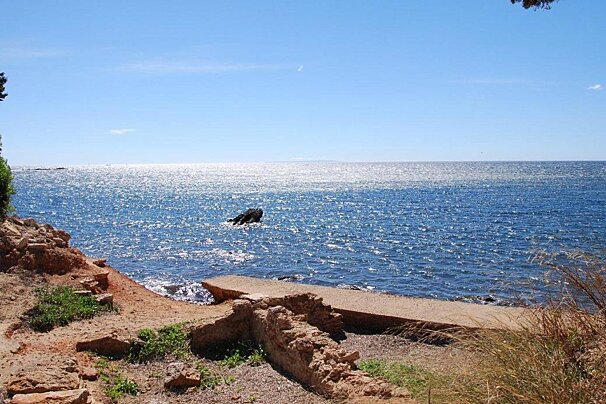
6. S'Argamassa Roman Aqueduct

Built by the Romans in the 1st century AD, this aqueduct now runs for 425 metres and reaches 2 metres high at some points.

It was used to conduct water from a spring to a fish farm. Fish were kept inside stone tanks covered in plaster to make them waterproof. Specialists think that there was probably a manufacturing industry of "garum" (popular sauce made with fish, herbs and spices, vinegar and oil) in S'Argamassa.

You can still see the channel carved on the top surface of the aqueduct, where the water flowed.